 myGenogramhttps://mygenogram.com/symbols
Free guide
Genogram symbols, explained
A complete reference to standard genogram notation: shapes, lines, medical markers, and the conventions clinicians actually use. With a free downloadable cheat sheet.
Updated April 202611 min readGenogram Symbols Cheat Sheet ↓
A genogram is only as readable as its symbols. The shapes and lines look simple (squares, circles, slashes), but each one carries a precise meaning. Small differences (a doubled line vs. a tripled line, a dashed line vs. a wavy one) tell you completely different things about a family. This is the full reference to the notation in current clinical use, organized so you can look up any symbol while you are drawing.
The notation here follows the standard set out by Monica McGoldrick in Genograms: Assessment and Intervention, the closest thing the field has to a shared vocabulary. Where practitioners diverge from McGoldrick (and they do, in small ways), we say so.
Individuals: shapes for people
Each person on a genogram gets a shape that tells you their gender and whether they are still alive.
- Square: male
- Circle: female
- Square inside a circle: trans-male (assigned female at birth, identifies male)
- Circle inside a square: trans-female (assigned male at birth, identifies female)
- House shape (flat bottom, rounded top): non-binary or gender-nonconforming individual
- Circle with a question mark: unknown gender


Inside or beside each shape, write the person's name and birth year. If they have died, add the death year. By convention, the index person (the person whose family is being mapped, sometimes called the proband) is marked with a thick orange border around their shape, so the eye knows where the genogram is centered.

Two practical notes that get glossed over in most online references.
First, draw shapes large enough to write inside. A 1cm square will not fit "John 1962–2018, MI" in any handwriting. Plan for at least 2cm per shape on paper.
Second, the convention for couples places the older partner on the left. If a couple has a four-year age gap, that placement tells the reader who is older without arithmetic. This is the kind of small consistency that makes genograms readable across practitioners.
Deceased and health markers
A person who has died is marked with an X drawn through their shape — the same shape they had in life (square for male, circle for female), with two diagonal lines crossing through it.


A health indicator is drawn as a red half-fill at the bottom of the person's shape. This marks a person who carries a significant medical condition relevant to the genogram's purpose — the specific condition is written alongside the shape. In genetic counseling genograms, all people with the inherited condition under study are marked this way.

Birth status
Not every pregnancy results in a living child, and genograms track these outcomes because they often matter clinically. Each birth status gets its own small symbol, placed where a child would be on the family line.
- Triangle: pregnancy in progress
- Filled black circle: miscarriage (spontaneous loss)
- Small X: induced abortion
- Small square with X: stillbirth


Pregnancy losses are part of a complete genogram. They often turn out to matter clinically when the family has organized itself around an unspoken loss. Leaving them out is a common beginner mistake.
Couples: how relationships are drawn
Two people who are partnered are connected by a horizontal line between their shapes. The type of line tells you the relationship status.
- Solid horizontal line: married
- Solid line with dashed line above: committed relationship (cohabiting, engaged, long-term)
- Dashed horizontal line: couple / partnered (less formal than committed)
- Solid line with a single slash: separated
- Solid line with two slashes: divorced
- Solid line with two slashes crossed by a backslash: remarriage (after a previous divorce)
- Solid line with an X at the midpoint: separation that was later repaired
- Dashed line with a red triangle above: secret affair








If a person has had multiple partnerships, each gets its own connecting line. The convention places earlier partnerships farther from the index person, so a person's first marriage is drawn farthest, and the current partner closest. The year of marriage and divorce or end goes above each line.
This is the part of the notation that most beginners get wrong. It requires you to think about the page layout before you start drawing. If you have not planned the layout in advance, you will run out of space.
Children: who came from whom
Children connect to their parents by a vertical drop line from the parental relationship line. The style of the drop line tells you the type of parent-child relationship.
- Solid black vertical drop: biological child
- Dashed red vertical drop: foster child
- Solid black line paired with dashed red line: adopted child (the double line distinguishes adoption from biological and foster)
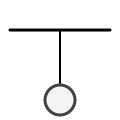
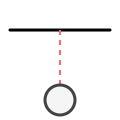
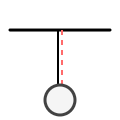
Multiple children of the same parents are drawn left-to-right in birth order, oldest on the left.
Twins
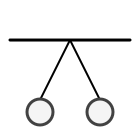
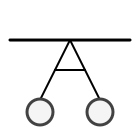
Twins have their drop lines converging to a single point on the parent line, forming a V shape. Identical twins additionally get a horizontal crossbar connecting the two legs of the V, marking the biological identity.
Relationship quality lines
This is the layer that distinguishes a genogram from a family tree. It also takes the longest to learn. Relationship quality is shown by the type of line drawn between two people, usually horizontal between adults, sometimes diagonal between non-adjacent generations.
Lines drawn in green indicate positive or neutral dynamics. Lines drawn in red indicate stress, dysfunction, or harm.
Positive and neutral
- Single green line: connected (functional, baseline relationship)
- Doubled green line: close
- Green line with arrow: focused on (one person is particularly attentive to another)



Conflicted and distant
- Tripled red line: fused or enmeshed (overly close, with poor differentiation)
- Red dashed line: distant
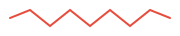
- Red zigzag line: hostile (conflicted)
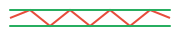
- Red zigzag between green parallel lines: close and hostile (the most common type of long-term family relationship)


Cutoff and repair
Cutoff is one of the most loaded words in family systems theory. It means a relationship where contact has been severed — not merely distant but actively ended. The distinction matters because cutoffs tend to ripple across generations. A father who cuts off his parents often finds his own children doing the same thing a generation later, sometimes without anyone naming the pattern.
- Red line with two vertical bars (||): cutoff (estranged, no contact)
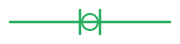
- Green line with two vertical bars and a circle: cutoff that has been repaired (reconciliation)

Abuse and control
These lines represent the most serious relational dynamics. Unlike the other relationship-quality lines, abuse markers are directional — they show who is directing the behavior toward whom, using arrowheads that point from the person doing the harm toward the person receiving it. The distinction between emotional, physical, and sexual abuse is clinically important because these patterns often co-occur but have different treatment implications, and a genogram that collapses them into a single "abusive" label loses information the clinician needs.
- Red zigzag with open (white) arrowhead: emotional abuse
- Red zigzag with filled arrowhead: physical abuse
- Triple red zigzag with filled arrowhead: sexual abuse
- Red zigzag with arrow, negative focus: focused on negatively (controlling, critical attention)
- Red line with double arrowhead (chevrons): caretaker dynamic (one person in a compulsive caretaking role)





You read these lines alongside the structural diagram. A family of four can have a calm structural layer (married parents, two children) and a relational layer that tells a different story: fused mother and daughter, conflicted father and son, distant siblings.
This layer is also where genograms become uncomfortable to draw about your own family. The structural shapes are easy. Writing "my relationship with my mother is fused and conflicted" on paper is harder. Take your time here.
Medical and behavioral markers
The third layer of a genogram records what each person carries: diagnoses, addictions, major events.
There is no single agreed-upon set of symbols for every possible condition, because the list is too long. The conventions that are standardized:
- AD: alcohol dependence (often written next to the shape, sometimes with the shape filled in)
- DD: drug dependence
- MH: mental health condition (specified by abbreviation: Dep for depression, Anx for anxiety, BP for bipolar)
- Dx + condition: any diagnosed medical condition (Dx CHD = diagnosed coronary heart disease)
- Red half-fill: used in some traditions to mark a person who has the condition being studied (in a genetic counseling genogram, all people with the inherited disorder are filled in)
For genograms used in genetic counseling and family medicine, the convention is more rigid. Each medical condition gets its own shading or pattern, and a legend goes at the corner of the page so the genogram can be read without context.
For genograms used in family therapy and trauma work, the convention is looser. Practitioners write the relevant condition in plain language next to the shape, in the style most compatible with their notes. The trade-off: less rigid notation requires more interpretation, and is therefore less useful for handing the genogram off to another clinician later.
Choose the level of formality that matches your purpose.
Conventions vs. variations
A working genogram is a compromise between standard notation (which makes the diagram readable to anyone) and personal annotation (which captures what you actually need to remember about a particular family). McGoldrick's notation is the canonical reference, but in practice every clinician adapts it slightly. Common variations:
- Some practitioners use color (red for conflict, blue for fusion) instead of line style. Useful on screen, useless on photocopies.
- Some use a separate "ecogram" layer to show relationships outside the family: work, friends, community. This blurs the line between a genogram and an ecomap.
- Some annotate generational events (war, migration, pandemic) with horizontal date bars across the diagram, so you can see what historical pressures the family was under at any given moment. This is borrowed from oral history practice and works well.
The standard gives you a starting vocabulary. When you depart from it, you can be clear about what you changed and why.
A note on what to do next
If this is your first time encountering genogram notation, the symbols will not stay in your head from reading alone. The fastest way to internalize them is to draw one. Pick a family you know well (your own, or a fictional one), give yourself an hour, and try to put it on paper. The how-to-draw guide walks through the process step by step, and the free blank template gives you the structural skeleton to fill in.
If you are working on a project where you will be drawing several genograms, the printable cheat sheet below will keep the notation in front of you while you work. It is one page, no signup beyond confirming your email, and it covers everything in this guide on a single sheet.
Free download
Free Genogram Symbols Cheat Sheet
Download our free genogram symbols reference card — all standard McGoldrick notation on one page.
Read next
How to Draw a Genogram: Step-by-Step Guide
Learn how to draw a genogram from scratch. This guide covers gathering information, choosing the index person, placing generations, and adding relationship markers.
McGoldrick Genogram Notation Standard
How Monica McGoldrick turned the genogram from a loose clinical tool into an international standard. The biography, the 1985 publication, the theory behind the notation, and what the system still cannot capture.
When you're ready
Build your genogram with FamRoots
A guided experience for transforming family history into healing narrative, built by the same team behind these resources. Pay per genogram, not per month.